Woburn, MA – On Wednesday, August 19th, the City of Woburn, Mystic River Watershed Association (MyRWA), Division of Marine Fisheries, and herring monitor volunteers celebrated the official groundbreaking of the new Horn Pond Fish Passage project. With construction beginning this month, the project aims to be complete before the next river herring migration begins in spring 2027.
Together we have reached this groundbreaking milestone thanks to decades of community advocacy, thousands of hours of volunteer data collection, and the generous support of Industri-Plex Natural Resource Damages Trustee Council, a North American Wetlands Conservation Act (NAWCA) grant, a Commonwealth of Massachusetts FFIO's Municipal and Tribal Technical Assistance (MTTA) grant, and a generous $1M gift from an anonymous foundation to the Mystic River Watershed Association.
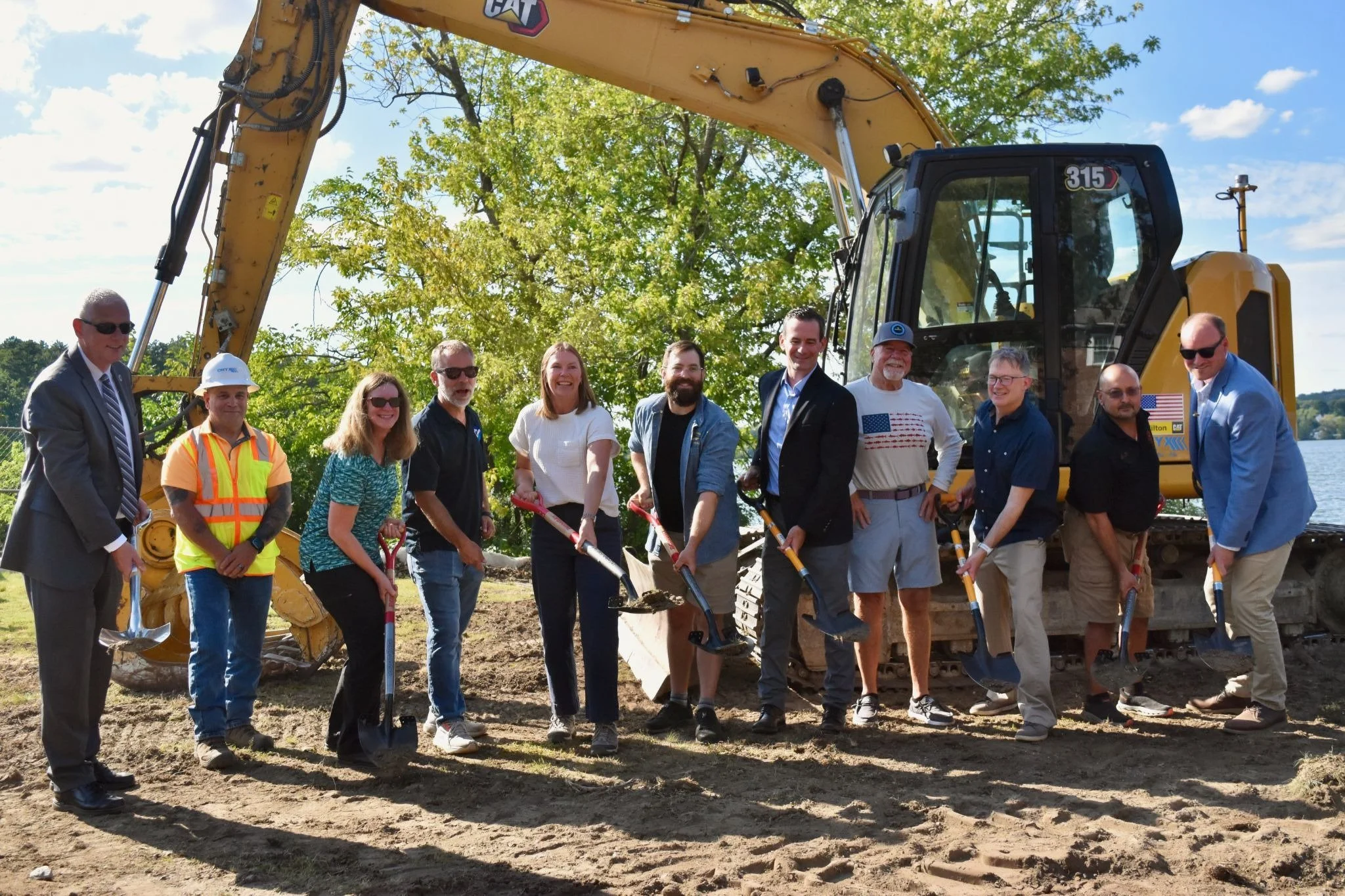
The official groundbreaking of the Horn Pond Fish Passage project - a moment of immense joy being in community with so many who care deeply about Horn Pond. From left to right: Woburn Mayor Michael Concannon, Kenny Quinto (Onyx Corporation), Theresa Murphy (Woburn Conservation Commission), Brian Kelder (Natural Resource Damages Trustee Council), Michelle Craddock (Natural Resource Damages Trustee Council), Joseph Holbeche (MA Division of Marine Fisheries), David Elmer (Weston & Sampson), Jeffrey R. Dillon (Woburn Ward Three Councilor), Lou Dimambro (Ward 6 City Councilor), Alex Rozycki (Woburn City Engineer). Credit: Isaiah Johnson
The official groundbreaking of the Horn Pond Fish Passage project - a moment of immense joy being in community with so many who care deeply about Horn Pond. From left to right:
This project will benefit river herring and the broader watershed community. The new fish passage at Woburn’s Scalley Dam will give river herring access to 100+ acres of spawning habitat in Horn Pond, finally re-establishing access to much of their ancestral range in the watershed. With this intervention at Horn Pond, it is estimated that the Mystic River herring run could reach over a million fish (Division of Marine Fisheries).
The new fish passage will also bring community members closer to the migration, providing educational opportunities to learn about how river herring connect freshwater and ocean food webs, and the role humans play in keeping our shared environment healthy and thriving. The fish passage includes multiple viewpoints, including a state-of-the-art underwater window to see river herring complete their 13-mile journey in real-time.
"This new fish passage will allow wildlife and the community to better access the beloved natural resource that is Horn Pond,” said Mayor Mike Concannon. “Kids and families from the Woburn community and beyond will be able to see the river herring migrating and learn about our connection to the watershed and the ocean. We are proud to host such a transformative project and are grateful to the volunteers, partners, and funders who have made this groundbreaking possible."
"That New England’s most urbanized watershed hosts one of Massachusetts’ largest river herring migrations speaks to the vital importance of these waterways and the incredible dedication of everyone working to protect and restore them," said Patrick Herron, Executive Director of the Mystic River Watershed Association. "We are deeply grateful for the many partners, volunteers, and supporters making it possible for herring to clear this final barrier to their ancestral freshwater spawning habitat."
"The restoration efforts occurring in the Mystic River Watershed represent one of the most successful restoration stories for sea-run fish in Massachusetts,” said Joseph Holbeche, Diadromous Fish Biologist with the MA Division of Marine Fisheries. “This work is being undertaken with a multitude of partners and the involvement of the community which underscores the widespread concern and status of these small but important fish."
The Horn Pond Fish Passage is the third fish passage project along the river herring migration route in the Mystic River, following fish ladders constructed at the Mystic Lakes Dam in 2012 and at the Center Falls Dam in 2017. Future data collection efforts by MyRWA volunteer herring monitors will study the impact of this new fish passage and raise other possible improvements for river herring in the region.
###
About the Mystic River Watershed Association:
The Mystic River Watershed Association works to improve the lives of the more than 600,000 residents of Mystic River communities through its efforts to protect and restore water quality, natural habitat and open space throughout the 76 square mile watershed. The Mystic River watershed is comprised of 21 communities: Arlington, Belmont, Boston (Charlestown & East Boston), Burlington, Cambridge, Chelsea, Everett, Lexington, Malden, Medford, Melrose, Reading, Revere, Somerville, Stoneham, Wakefield, Watertown, Wilmington, Winchester, Winthrop, Woburn. For more information, see www.MysticRiver.org.