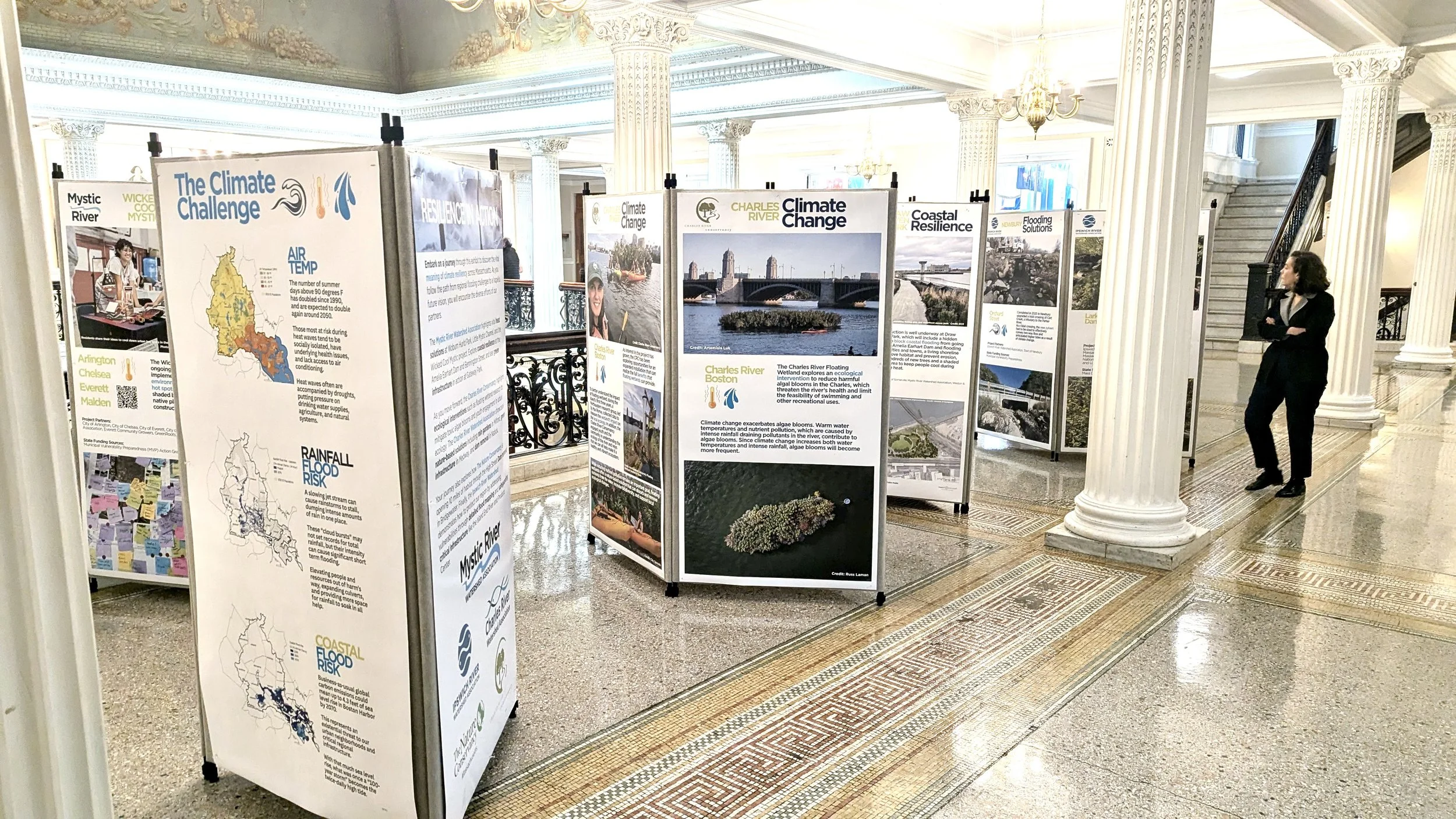
Climate exhibit at the State House during a Resilient Mystic Collaborative legislative briefing in April. Credit: Nasser Brahim
One of the most important pieces of legislation for Massachusetts’s climate future is being negotiated at the State House this summer and fall. The “Mass Ready Act” environmental bond bill is with a Conference Committee – it’s the last stop before being voted on and signed into law. This bill will allocate billions of dollars and enact new policies to advance statewide climate resilience and environmental priorities. The Mystic’s own Representative Christine Barber (34th Middlesex) is one of the six legislators on the committee.
Governor Healey filed the Mass Ready Act last summer, and it has been working its way through the Massachusetts Senate and House of Representatives for the past year. As it has made its journey, MyRWA, our legislators, and partners have been advocating for investments and policies that will make Mystic communities more resilient to climate change and increase access to nature and a healthy environment.
As it stands, the House and Senate produced different versions of the bill. They will use the Conference Committee to agree on a final version. In this final stretch, we wanted to share some of the programs, projects, and policies that we are most excited about:
Municipal Vulnerability Preparedness (Senate Section 2000-7088)
The Municipal Vulnerability Preparedness (MVP) grant program is the only statewide grant program in Massachusetts dedicated specifically to climate resilience. It funds municipalities and non-profit partners like MyRWA to carry out projects that make our communities safer from climate change impacts like extreme heat, sea level rise, and flash floods. It also emphasizes community engagement, requiring cities and towns to plan alongside community members and pursue the solutions everyday people most want to see.
The Resilient Mystic Collaborative - a municipally-led partnership that facilitates regional coordination, capacity building, and innovation to build climate resilience in the Mystic - has secured over $35 million in MVP funds since 2018. Without MVP’s support, we wouldn’t have resilient open spaces, like Malden River Works, Woburn’s Hurld Park, Reading’s Maillet, Sommes & Morgan, or the Stoneham High School wetland to keep heavy rains from flooding streets and basements and provide cool outdoor spaces to play and access nature. Residents in Arlington, Chelsea, Everett, Malden, and Revere wouldn’t have new shade shelters or drinking fountains at transit stops that used to bake in the summer heat. Our coastal communities would not have shovel-ready projects like Island End River and Bennington Street and Fredericks Park to compete for the hundreds of millions of dollars in federal and state funding needed to keep rising seas and storm surge from devastating environmental justice neighborhoods and the critical infrastructure and threatened ecosystems they host. But there is so much more need than MVP can support. Last year, MVP had to turn away $80 million in funding requests - 75% of requests statewide - including eight impactful projects in the Mystic.
MyRWA has long been advocating for $500 million over five years for the MVP program in the Mass Ready Act alongside the Massachusetts MVP Coalition, a group of allied municipal, watershed, economic development, and regional planning organizations from across the state. The Senate version of the bill included $500 million for MVP, but the House version only has $315 million. We continue to advocate for $500 million in the final version.
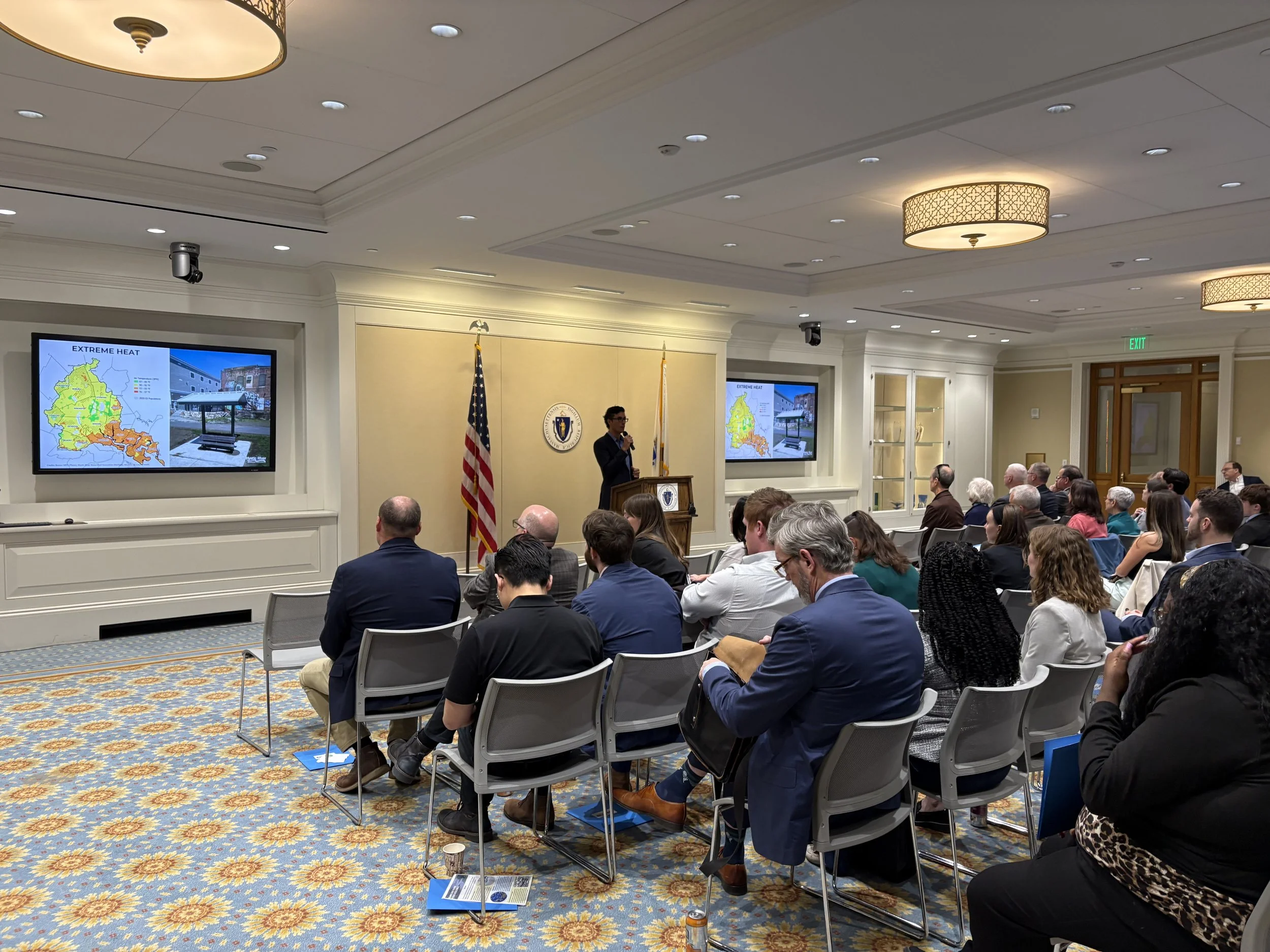
MyRWA Director of Climate Resilience Nasser Brahim presents to legislators and partners on extreme heat projects funded by MVP. Credit: Grace Gallagher
Some of the other regionally significant projects and programs we support include:
Securing Critical Coastal Flood Pathways - In addition to MVP funding, we hope to see the Mass Ready Act include specific line items for critical projects that protect our communities and the regional infrastructure we rely on from coastal flooding, including elevating the Amelia Earhart Dam and constructing flood protection systems and waterfront access improvements at Island End River and in East Boston.
Funding for the Department of Conservation and Recreation (DCR) - We rely on our partnership with DCR to care for the many parks and paths along the Mystic. DCR needs a sustainable level of funding to fulfill its mission to build a healthier, more resilient Massachusetts where all residents and visitors can relax, reflect, and feel a sense of belonging in our open spaces and public lands.
Combined Sewer Overflow Remediation at Alewife Brook - Combined sewer overflows (CSOs) are a regional issue that demand region-scale investments. We are fighting to secure millions of dollars for sewer separation projects to address Combined Sewer Overflows at Alewife Brook.
The Mass Ready Act also includes many policy proposals. Among those, we support policies that will:
Establish a technical air quality advisory committee to guide state air quality monitoring strategy and investment (House Section 11)
Plan for the impact of droughts (Senate Section 13)
Establish a Municipal Reforestation Program to help communities expand and protect urban tree canopy (Senate Section 16)
Reduce plastic pollution (Senate Section 19)
Streamline permitting for nature-based solutions, ecological restoration, and coastal resilience projects (Senate Sections 25, 51, 105, and 107)
Require sellers and landlords to disclose flood history and risks to residential homebuyers and renters (House Section 66)
Authorize cities and towns to regulate rodenticide use to protect birds of prey, other wildlife, and pets from poisoning (Senate Sections 74 and 75)
You can read our letter to the Conference Committee here. If you want to help support our advocacy around the Mass Ready Act, reach out to your elected representatives.

FAE, a beloved bald eagle that died of Second Generation Anti-Coagulant Rodenticide (SGAR) poisoning this spring. Photo: Frank Killoren