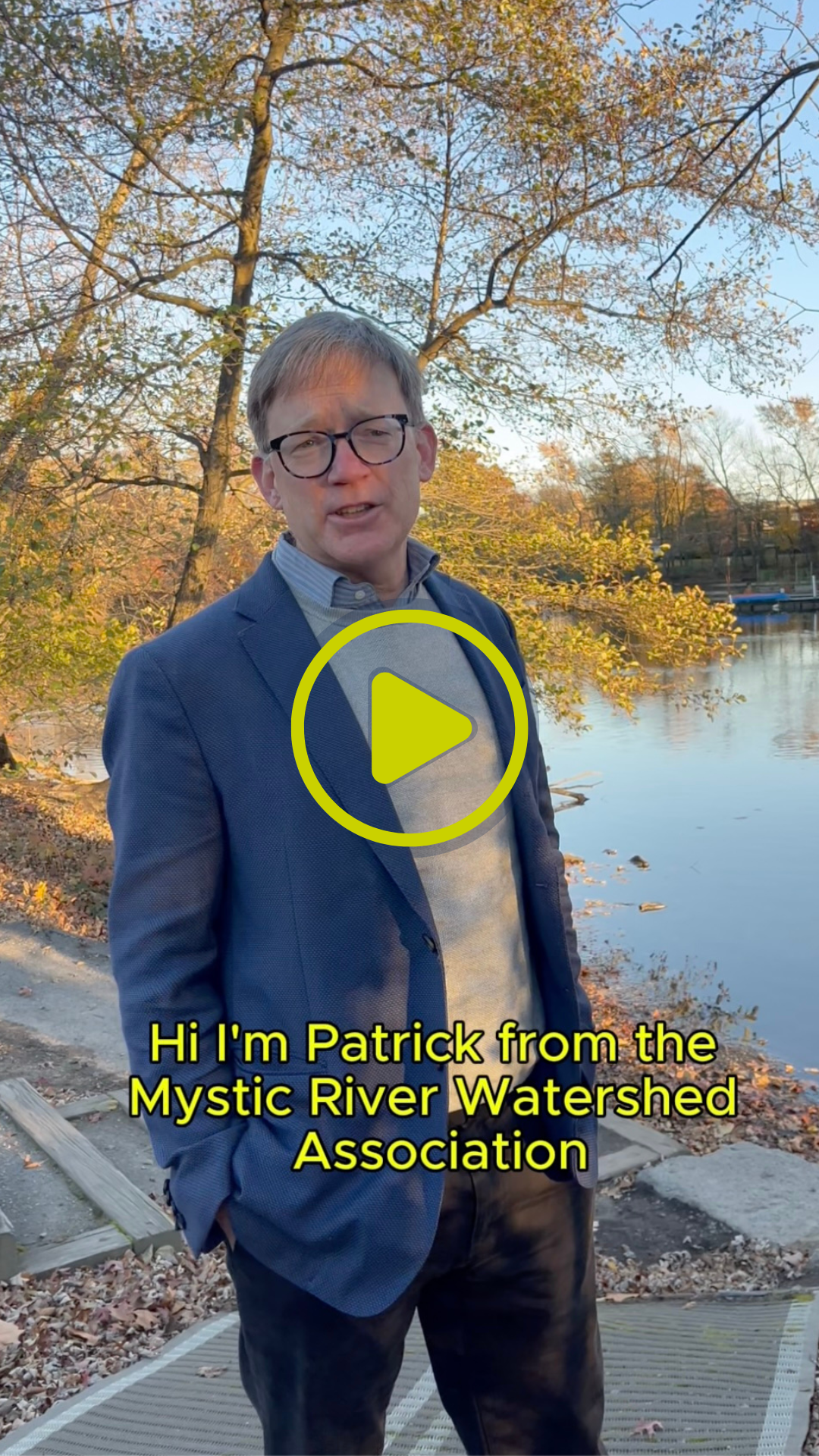
Click to hear Patrick’s message.
At the Massachusetts Water Resources Authority (MWRA) Board of Directors meeting on November 19th, board chair (and EEA Secretary) Rebecca Tepper began by acknowledging that we are in the midst of a generational moment for the future of sewage pollution in Boston and that more time is needed to produce a plan that prepares our cities for the climate of the future — so that we don’t see more and more sewage dumped into our rivers and streams in perpetuity.
This acknowledgement came after public outcry toward a draft plan that would have doomed the Mystic, Charles, and Alewife to ever-increasing amounts of raw sewage. To everyone who joined us in emailing, writing, and calling — Thank you. Your voices were heard.
This week, MyRWA and the Charles River Watershed Association (CRWA) sent a letter to Mass EEA and Mass DEP, laying out what we would like to see as the project teams spend the next few weeks reworking their proposal. In particular, we are asking for the elimination of CSOs, a commitment to increased transparency around costs, benefits, and potential future volumes with opportunities for robust public discussion. Finally, the reclassification of any water body to Class B (CSO) must be off the table.
How did we get here?
For over a century, Boston Harbor and the rivers that flow into it have been contaminated by raw and partially treated sewage discharged during heavy rain. The MWRA was created, in part, to lead a decades-spanning effort to clean up the harbor and close combined sewer outfalls, working alongside cities and towns. For the past two years, the cities of Cambridge and Somerville and the MWRA have been working on an updated “Long Term Control Plan,” and MyRWA, CRWA, and Save the Alewife Brook (StAB) have been advocating for the virtual elimination of CSOs.
As we have approached the December 31st deadline for submitting a draft plan, CSOs have been in the news. Here is what has happened since September (click the + for details and links to news coverage):
-
-
MWRA presents "preferred alternatives" to the Somerville City Council. They include the least or next-to-least ambitious alternatives for the Mystic, Charles, and Alewife.
MyRWA and CRWA write letters to the MWRA Board of Directors and are invited to speak at the end of the October 29th board meeting
-
MWRA engineers present “preferred alternatives” to their Board of Directors, MyRWA and CRWA speak, expressing concern about the plan and the risk of a potential downgrade of the rivers’ classifications. This news is covered widely.
-
In response to the proposal, allies and community members — including many of you — raise their voices calling on the MWRA to produce a better plan before they vote on the current proposal at their November 19th Board Meeting.
-
-
November 19th - MWRA board meeting opens with a statement from Sec. Tepper acknowledging that there is more work to be done and indicating that they should seek a higher level of control. DEP writes a letter to MWRA, Cambridge, and Somerville with a similar message, inviting the parties to request more time to come up with better alternatives.
MyRWA and CRWA file motion to intervene in the federal Boston Harbor Cleanup case, a legal measure that runs in tandem with our advocacy around the updated LTCP.
Where are we now?
CSO Long Term Control Plan Schedule (from September 25th Public Meeting Slides). Click to enlarge
As we head into 2026, MWRA and the cities of Somerville and Cambridge are approaching the end of this multi-year planning process. Once their draft plan is submitted, it will be up to the US Environmental Protection Agency (EPA) and the Massachusetts Department of Environmental Protection (DEP) to review the plan and ultimately approve it.
We know that we will continue to need to make all our voices heard during the rest of this process. Sign up for the Mystic River Watershed Association e-news to stay up-to-date. Finally, consider donating to the Mystic River Watershed Association to support our work and help us continue our advocacy.