Hello everyone, and I am your host, Watershed Field Scientist, Jennifer Delgado, and I’m excited to welcome back to another installment of Interview With a River!
Last year, we spoke with two of the most well-known tributaries in the Mystic River watershed: Alewife Brook and Aberjona River. They told us stories from their past — encounters with people and the age of urbanization — and shared their hopes for the future. Today, we are excited to introduce another very special tributary of the Mystic, Island End River, a small saltwater river that flows through the cities of Chelsea and Everett.
Jennifer: Welcome, Island End River! Thank you for joining in. It is so good to see you.
Island End: Likewise, thank you for having me. Being on this program is a "stream" come true!
J: The pleasure is all mine! I wanted to start off with a question about your past. I know from talking to other rivers that our whole region has gone through a lot of change over the years. If you think back to before all the cities were built, how do you think you have changed?
I: I’m very different from the river I once was. I’ve always been a tidal branch of the Mystic River, connected to the Boston Harbor and the ocean. I used to flow in and out of big salt marshes, mudflats, and small creeks. At high tide, I would cover the whole area with water. But in 1789, landowners built a dam and a dike “for the purpose of fencing out the sea,” as they put it, to create dry farmland.
J: Wow, a dam! Now that sounds like a huge transformation.
I: Yes, indeed it was. Afterwards, in the 1890s, people started filling in the marshes around me to create more land for industries like coal processing. Then, in the 1960s, they dug a culvert for me to flow underground to create even more dry land. In short, people have been trying to keep me out for nearly 250 years, but I can’t help myself. When the tide is high, I have nowhere to go but inland!
1857 U.S. Coast Survey Map of Boston Bay and Harbor, Massachusetts - Geographicus. Click to Enlarge
Mystic and Island End Rivers in 2o26, Credit: Google Maps. Click to Enlarge
J: That’s a big change, Island End. As the city has grown around you, I imagine you’ve had to interact with lots of people in your lifetime. Has that caused you any problems?
I: *Gurgles with laughter* Yes, it has. I can tell you two stories that some readers might be interested in. The first has to do with a coal tar processing plant. The plant would store coal tar and turn it into different chemicals, but it would send waste from the process directly into me.
J: Oh no! That sounds awful.
I: Yes it was. But then in the 1980s, the Coast Guard noticed an oily patch where I met up with the Mystic River. The Massachusetts Department of Environmental Protection investigated and found other yucky chemicals in my sediments. There has been an extensive cleanup, which helped the problem, but it still isn’t totally fixed.
J: I actually did not know about the tar processing plant. Thank you for telling the story! It seems that at the same time that you were harmed by people, you were also helped by them as well.
I: That's true! This second story, which many of our readers might be familiar with, emphasizes that relationship a little more. In 2006, an ExxonMobil storage facility on the Mystic River, just upstream of where we join together, spilled 15,000 gallons of oil because of some faulty equipment. I was covered with a foul-smelling oily sheen, which also traveled out into Boston Harbor. Because of this pollution and the site’s vulnerability to rising seas, the company faced community backlash and big lawsuits through the 2010s, and they ended up closing the facility in 2022.
J: Wow, your relationship with people is really complex. Have you found that your relationship has changed throughout the years?
I: People used to understand nature differently than they do today, and not just in Massachusetts. But I actually love so many things about the communities that surround me. There are 5,000 people living in my floodplain, many of whom volunteer to clean up my riverbanks or advocate against polluting practices and for restored wetlands. Community-based organizations like GreenRoots, the Neighborhood of Affordable Housing, and more help bring people together for a healthy environment!
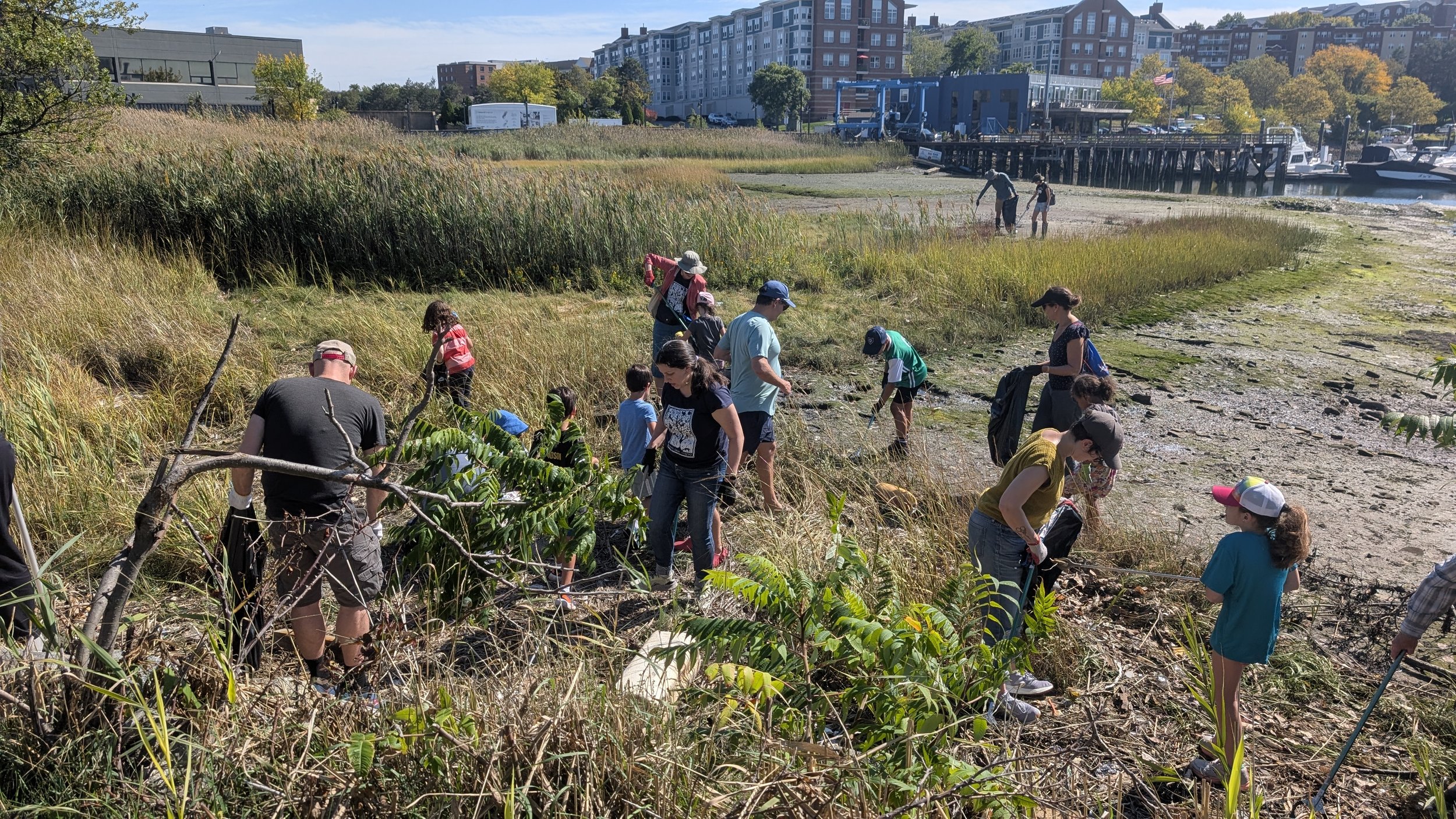
Trash cleanup at Island End River in September 2025. Credit: Sushant Bajracharya
I: Also, some of the things people have built around me are really valuable. For example, the New England Produce Center supplies fruits and vegetables to 9 million people across all six New England states and the Canadian Maritimes. My floodplain also includes a commuter rail line serving the entire North Shore, a regional health care center, and major shipping and commuting routes serving thousands of people and trucks every day!
J: I see! It sounds like you do have some really great neighbors, and your floodplain seems important to the whole region. Is there anything you and your neighbors are worried about in the future?
I: Yes. As a tidal river, I tend to flood the land around me more often as the sea level rises. The sea in Boston Harbor has already risen nearly a foot in the past 200 years, most of that in the last century. I overflow my banks about once a year now, but that will happen almost weekly by 2030 and twice per day by 2050. In the coming decades, I might flood the area to the level of the flooding we saw in New York during Hurricane Sandy.
Rendering of projected flooding during a 1-in-100 year storm in 2070. Credit: City of Chelsea. Click to enlarge
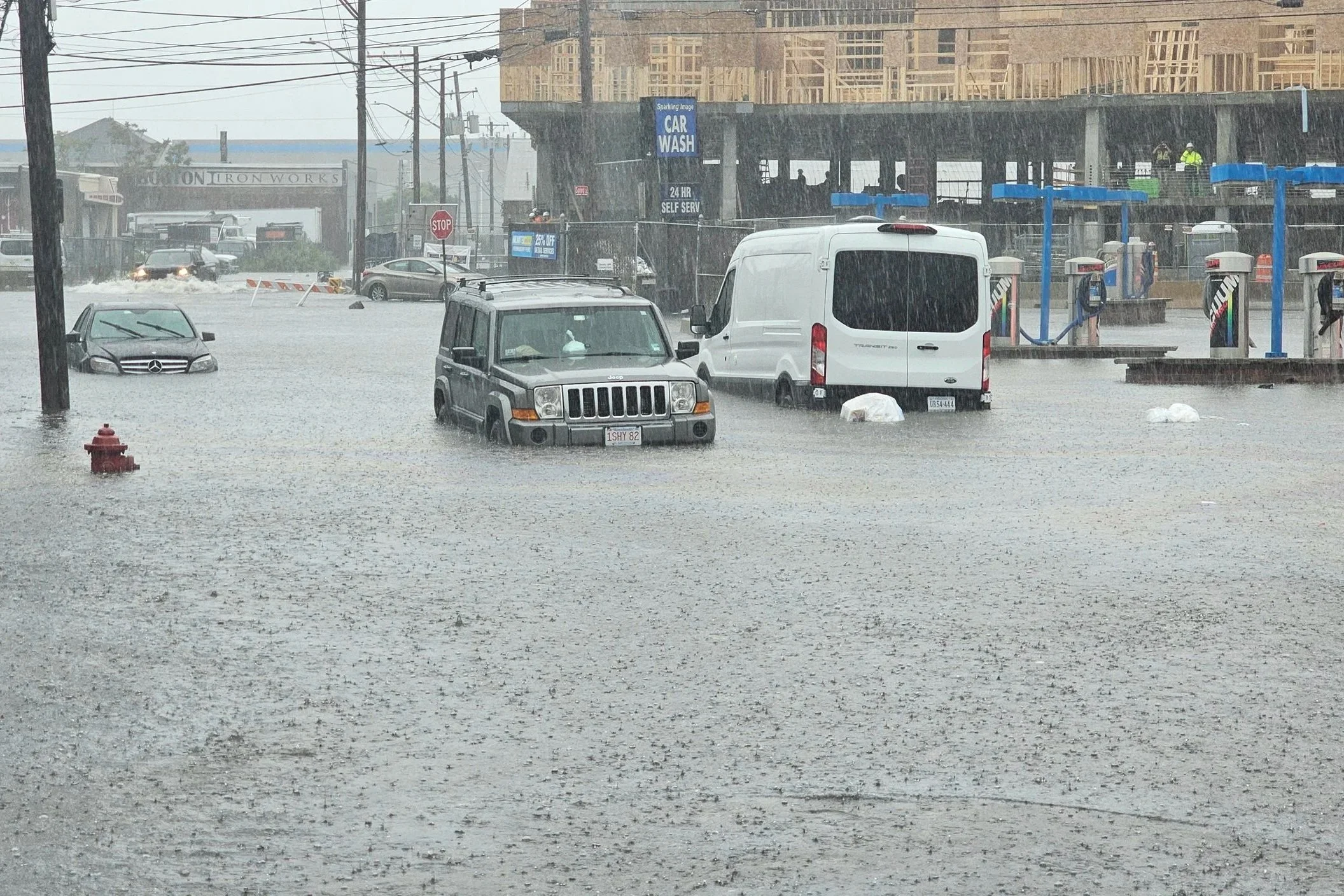
Flooding from Island End River in the City of Everett in August 2023. Credit: Patrick Johnston
J: I am so sorry, Island End River. This must be uncomfortable for you and the people around you. Is there something that is being done to prevent this flooding?
I: Yes, it is actually one of the projects I am excited to talk about! My friends in the cities of Everett and Chelsea have designed the Island End River Flood Resilience Project to keep my waters out of populated areas, regulate storm surge, and restore the wetlands around me.
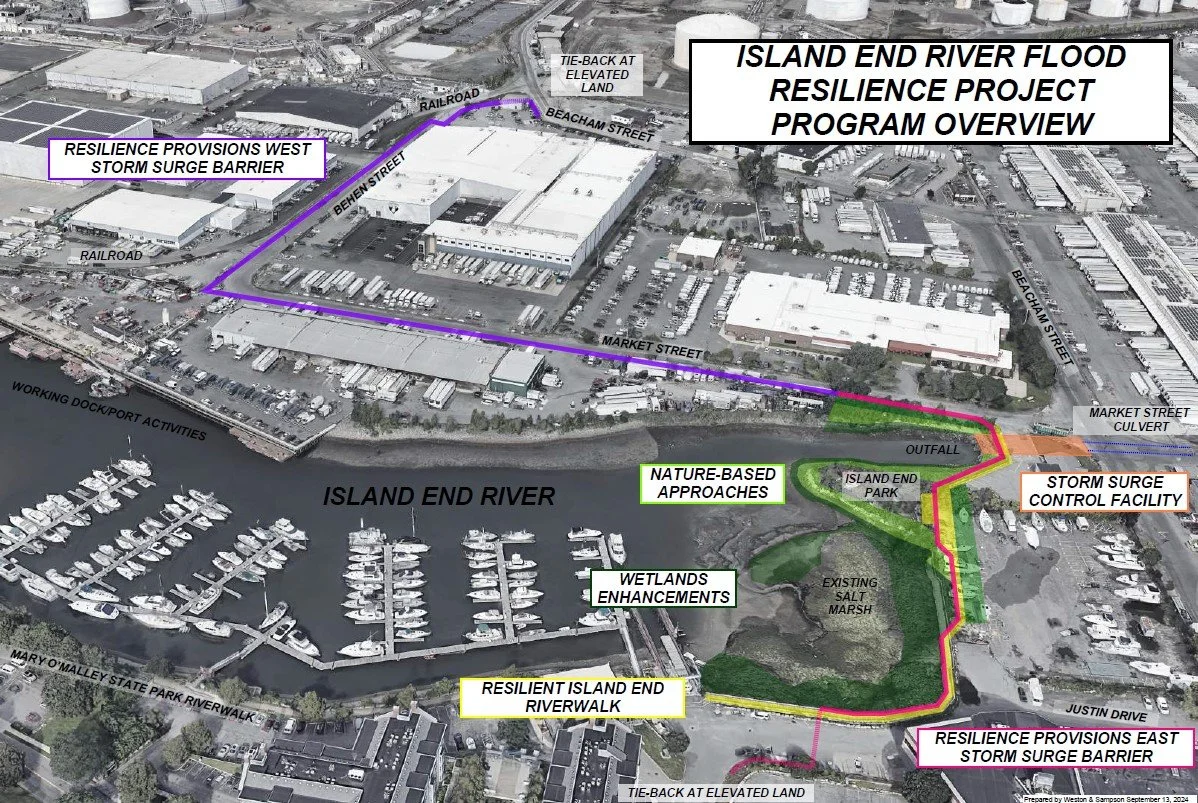
Proposed solutions as part of the Island End River Flood Resilience Project include: a coastal storm surge barrier, storm surge control facility, nature-based solutions along the riverfront, and other related amenities.
J: This gives me so much hope, Island End! Is there anything a regular person can do to help make sure you and your neighbors are protected?
I: Chelsea and Everett can’t afford to build the project themselves, especially after the federal government eliminated a grant program that was set to provide $50 million. People can remind their federal and state legislators that projects like this are urgently needed, and those who work in philanthropy, universities, or the nonprofit sector can reach out to Everett and Chelsea to explore ways to support the project.
J: I'll be sure to spread the word. Thank you for joining us today and for telling us your history and your future!
I: Of course! There’s so much to look forward to, but it can only happen if a confluence of people acts as one.
This installment of Interview with a River, with questions from Jennifer Delgado, was developed by the Mystic River Watershed Association and the Cities of Chelsea and Everett.
To learn more about the Island End River Flood Resilience Project and find out how you can help, visit the project website and contact the project managers for Chelsea and Everett:
egranoff@chelseama.gov, (617) 543-1065
Patrick.johnston@cityofeverett.org, (617) 905-3747